
THE STORIES
Occupational Hazards
In February 2024, interventional cardiologist Dean J. Kereiakes, MD, required emergency cervical decompression surgery. Neurosurgeons stated he would likely have been quadriplegic without immediate intervention.
He is not alone.
Up to 65.7% of interventional cardiologists require non-operative treatment
Up to 34.3% require surgery
Up to 31% require time off work due to pain


After a debilitating spinal injury from years of wearing lead, Rampart founder and interventional cardiologist Dr. Bob Foster was nearly forced to walk away from the profession he loved.
The protection meant to keep him safe was slowly breaking him.
That moment became a mission: build a better way.

Bill Orrison was an interventional neuro-radiologist, and he loved helping people through his medical practice. He was exposed to radiation while performing interventional procedures throughout his career. Like many others, Bill worked long hours in the lab with minimal protective devices. Bill was one of the pioneers in interventional radiology and a proponent of radiation safety. In his later years he developed novel radiation protection devices. However, the many years in the lab without adequate protection led to several health issues which then led to a debilitating heart attack. Bill passed away a year later.
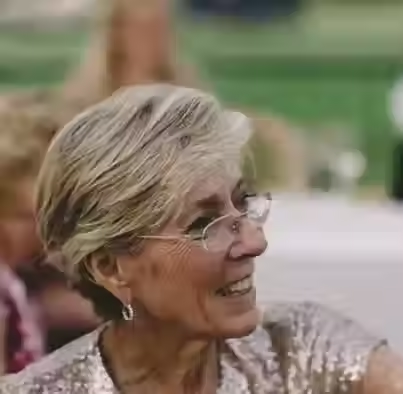
Dr. Sarah Sullivan “Sully” Johnson, was a great cardiologist. In 1978, at only 36 years old, she was named the Director of the Cardiac Catheterization Laboratory at Loyola University Medical Center.
She trained countless fellows at Loyola before going into private practise.
She developed an appendiceal tumor, for which she had 10 years of chemotherapy and multiple surgeries – and eventually succumbed.

Lou McKeever was a cardiologist at a time when cardiology was changing people’s lives through innovative procedures. He was one of the brightest and he loved his patients - many of whom knew Lou for almost 30 years.
At age 48, he was diagnosed of stage four colon rectal cancer. He went through surgery and periods of recovery, and when possible, he never stopped practicing. He finally retired at age 65 and about two years later he developed dementia.
For six years he battled through with grace until he passed away.

Aged 20, Sheehan Raab was living and working in New York City. Sheehan recalls how the leads available to her at the time in the cath-lab were best suited to men with the larger sizes not offering her adequate protection.
In 2018 Sheehan felt a lump in her upper breast and a mammogram revealed what was thought to be stage-1 breast cancer.
Soon after it was discovered that her breast cancer was actually stage-3 and affected both breasts. At this point a double mastectomy was the only option available to her.
Sheehan has thankfully made a full recovery and is now passionate advocate of radiation awareness and encourages those who fight for patients health every day to consider their own health too.

Cass Pinkerton was one of the founders of interventional cardiology.
The use of lead and cases for radiation protection (and potentially radiation exposure) caused Cass a severe cervical neck disease, which lead into multiple operations and chronic pain.
He had to leave his dream job in the cath lab which left him devastated and sadly lost his life years later.

Juan Palomar, MD trained in Spain and the United States, becoming an early pioneer in Pediatric Urology. For five decades, he treated infants and adults using fluoroscopy for complex urological conditions — work that exposed him to scatter ionizing radiation.
In 2017, Juan was diagnosed with an extremely aggressive, chordoma in the center of his brain. He knew immediately that it was due to decades of ionizing radiation exposure from fluoroscopy. Despite extensive treatment, he died 11 months later, leaving behind his wife, young daughter, and a community who loved him.

Tom Eagan trained as an interventional cardiologist. In the late 80s he started practicing full time, and by the early 90s he got to work seven days a week in the cath lab doing a high volume of coronary and interventional procedures.
In the mid 2000s, he developed a number of skin cancers that were thought to be caused by sun exposure. However, a few years later, he started to develop skin cancers at a rapid rate, not only monthly but daily – having to have many surgeries and procedures that ultimately remove him from the cath lab.

Dr. Pat Scanlon was director of the cardiac catheterization laboratory at Loyola from 1970-1978; director of clinical cardiology from 1978 to 1982; director of the cardiology fellowship program from 1982 to 1990; and chief of the section of cardiology from 1982 to 1993.
At the age of 67 he died of a left sided brain tumour – a glioblastoma.
